

A Comprehensive Guide to Modern Investing in the Digital Age
The investment world stands at a pivotal crossroads where cutting-edge technology meets traditional financial wisdom. Today’s investors have unprecedented access to sophisticated tools powered by artificial intelligence, machine learning algorithms, and advanced computational systems that were once exclusively available to Wall Street giants. This transformation isn’t just changing how we invest—it’s fundamentally reshaping who can participate in wealth creation and how successful those efforts can be.
What makes this revolution particularly exciting is its democratizing effect. Technologies that once required massive infrastructure and specialized teams are now accessible through user-friendly applications on smartphones. Whether you’re a seasoned institutional investor managing billions or an individual just starting your investment journey, the playing field has never been more level. Let’s explore how this technological transformation is unfolding across every aspect of modern investing.
Understanding Modern Investment Strategies
Investment strategies have always served as the fundamental framework guiding investors toward achieving their financial aspirations. These approaches are inherently personal, shaped by individual circumstances, financial objectives, comfort with uncertainty, and long-term goals. What’s fascinating about today’s investment landscape is how traditional wisdom is being enhanced—not replaced—by technological capabilities that previous generations could only dream about.
Historically, investment decisions relied heavily on human intuition, decades of experience, and pattern recognition developed over countless market cycles. While these elements remain valuable, they often struggled with limitations like processing capacity constraints, unconscious biases, and slower reaction times to rapidly changing market conditions. The marriage of traditional expertise with modern technology is creating hybrid approaches that leverage the best of both worlds.
Traditional Approaches That Still Matter
Before diving into technological innovations, it’s worth understanding the foundational strategies that have guided investors for generations. Growth investing focuses on identifying companies positioned to deliver exceptional future returns, essentially betting on tomorrow’s market leaders. This approach requires vision and the patience to wait for potential to materialize into profits.
Value investing, popularized by legendary investors, takes a contrarian view by seeking undervalued stocks that the market has overlooked or temporarily dismissed. This strategy assumes markets sometimes overreact, creating opportunities for patient investors who can identify genuine quality beneath surface-level concerns. Quality investing emphasizes the fundamental strength of companies themselves—their management, competitive advantages, and operational excellence—rather than short-term market perceptions.
The buy-and-hold approach represents perhaps the most time-tested strategy, built on the premise that quality investments appreciate over extended periods despite short-term volatility. This method can incorporate elements from multiple strategies, creating diversified portfolios designed to weather various market conditions while capturing long-term growth.
Breaking Down Barriers to Investment Success
 How technology removes traditional investment barriers
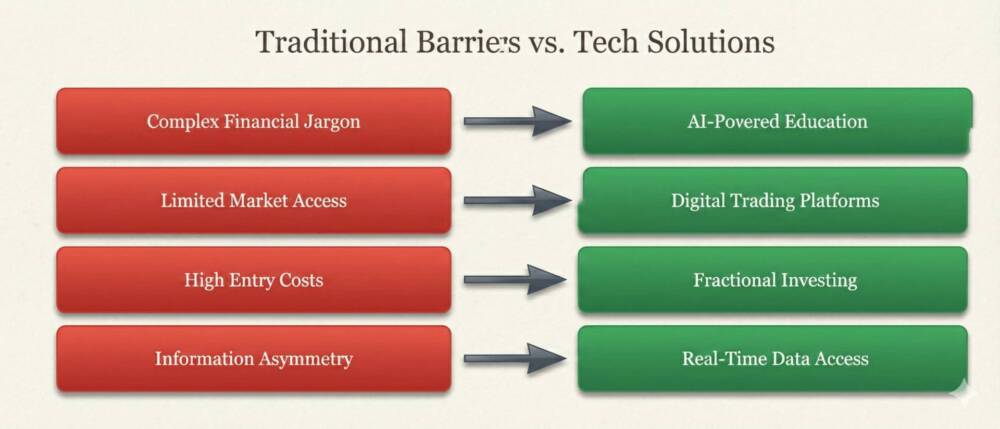
For decades, everyday individuals faced significant obstacles when attempting to build investment portfolios. The complexity of financial terminology, regulatory requirements, and product diversity created an intimidating landscape that discouraged participation. Educational systems rarely provided comprehensive financial literacy training, leaving most people unprepared to navigate investment decisions confidently.
European households, particularly those in France, have historically gravitated toward conservative options like bank deposits and government-regulated savings accounts. This preference persists despite inflation gradually eroding purchasing power. The hesitation stems from multiple factors: insufficient financial education, constantly shifting regulatory frameworks, difficulty assessing risk accurately, and an industry culture filled with technical jargon that alienates rather than welcomes new participants.
Technology is systematically dismantling these barriers through innovative solutions. Educational platforms now offer diverse learning formats—interactive videos, gamified lessons, podcasts, and comprehensive courses—making financial literacy accessible and engaging. Virtual assistants powered by artificial intelligence provide continuous support, answering questions and explaining concepts in plain language. Real-time simulation tools allow prospective investors to experiment with different strategies without risking actual capital, building confidence through hands-on experience.
The Data Revolution in Investment Decision-Making
 Comparison of data processing capabilities: Traditional vs. AI-Powered methods
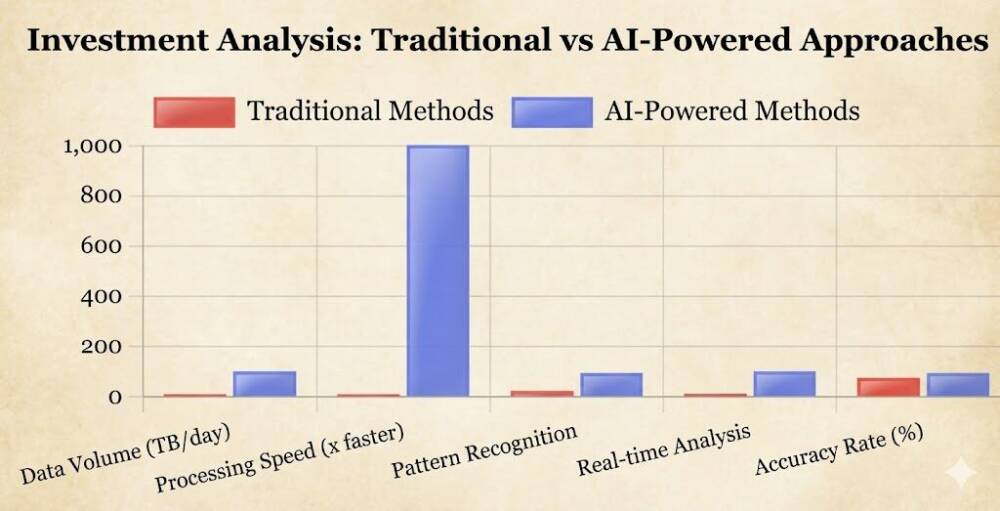
Perhaps the most transformative aspect of modern investment technology is the unprecedented ability to process massive volumes of information. Traditional analysis methods, while valuable, simply cannot match the speed and comprehensiveness of contemporary computational approaches. Artificial intelligence systems can analyze thousands of data points simultaneously, identifying patterns and relationships that would take human analysts months or years to uncover.
This computational power translates directly into superior investment insights. Portfolio managers can now detect market inefficiencies in real-time, dynamically adjusting asset allocations to capitalize on emerging opportunities. Multi-asset tactical allocation strategies automatically rebalance based on changing conditions, optimizing performance without constant manual intervention. The algorithms examine everything from traditional financial metrics to alternative data sources like social media sentiment, consumer behavior patterns, and macroeconomic indicators.
The sophistication of these systems extends beyond mere number-crunching. Machine learning algorithms continuously improve their accuracy by learning from outcomes, refining their predictive models with each market cycle. They can process unstructured data—news articles, earnings call transcripts, regulatory filings—extracting meaningful signals from noise. This capability represents a quantum leap from traditional approaches that relied primarily on structured financial statements and historical price data.
Artificial Intelligence: The New Investment Partner
 The interconnected capabilities of AI in modern investment strategies
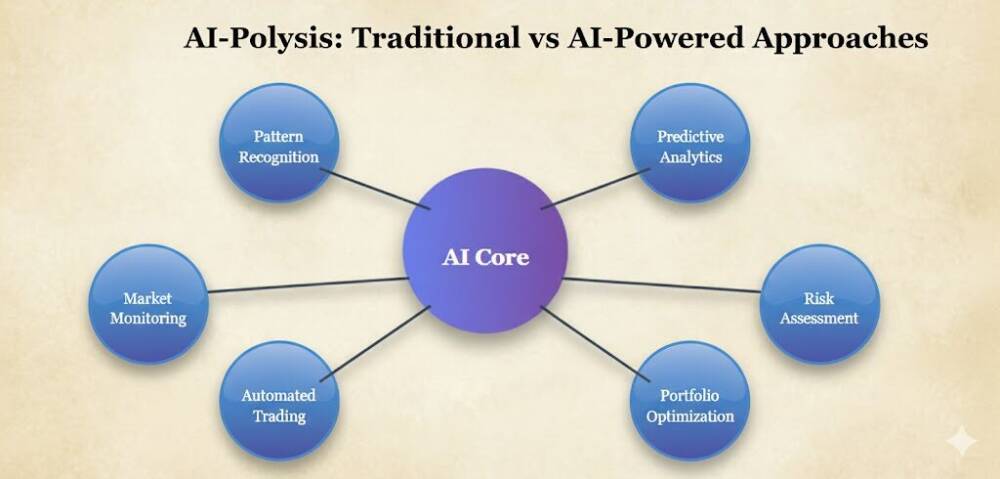
Artificial intelligence has emerged as a genuine game-changer in investment management, offering capabilities that fundamentally alter what’s possible in portfolio construction and management. Unlike traditional computational tools that follow rigid programming, AI systems learn, adapt, and improve over time, developing increasingly sophisticated understanding of market dynamics and relationships.
The speed advantage alone represents a revolutionary change. AI-powered systems operate at computational velocities measured in milliseconds, identifying and acting on opportunities before human traders even recognize they exist. In volatile markets where conditions change rapidly, this speed differential can mean the difference between capturing profits and missing opportunities entirely. High-frequency pattern recognition allows these systems to detect subtle shifts in market sentiment or emerging trends that human observers might not notice until they’ve already matured.
Beyond raw speed, AI excels at managing complexity. Modern markets involve countless interconnected variables—interest rates, currency fluctuations, commodity prices, geopolitical events, corporate earnings, consumer sentiment, and technological disruptions, to name just a few. AI systems can simultaneously monitor and analyze all these factors, understanding their relationships and predicting how changes in one area might ripple through others. This holistic perspective enables more accurate forecasting and better-informed decision-making.
Scalability and Flexibility
One of AI’s most valuable characteristics for institutional investors is its inherent scalability. Traditional investment processes often struggle when expanding across multiple asset classes, geographic regions, or portfolio sizes. Each expansion requires additional analysts, more research resources, and increasingly complex coordination. AI-based systems, by contrast, can scale almost infinitely without proportional increases in cost or complexity.
A single AI platform can simultaneously manage strategies across equities, fixed income, commodities, currencies, and alternative investments. It can operate across global markets spanning different time zones, regulatory environments, and economic conditions. This flexibility allows investment firms to offer comprehensive solutions without maintaining separate teams and systems for each market segment. However, achieving this scalability requires robust technological infrastructure, particularly high-performance computing systems and flexible architecture capable of handling massive parallel processing.
Superior Risk Management
Perhaps AI’s most compelling advantage lies in risk management capabilities. Traditional approaches to risk assessment often rely on historical patterns and statistical models that assume relatively stable relationships. These methods can fail dramatically when markets enter unprecedented territory or when correlations shift unexpectedly. AI systems, particularly those employing machine learning, continuously update their understanding of risk factors based on current market behavior.
These systems can forecast volatility with remarkable accuracy by processing real-time information flows and detecting early warning signals of market stress. They identify changes in investor behavior, shifts in liquidity conditions, and emerging correlations that might indicate systemic risks. Mathematical optimization algorithms then adjust portfolio allocations to maintain desired risk profiles even as market conditions evolve. This dynamic approach to risk management provides significantly better protection than static models based solely on historical relationships.
Robo-Advisors: Democratizing Professional Management
The emergence of robo-advisory platforms represents one of technology’s most democratizing contributions to personal finance. Historically, access to professional portfolio management required substantial wealth—typically hundreds of thousands or millions of dollars—placing it beyond reach for average individuals. Robo-advisors have shattered this barrier, making sophisticated investment management available to anyone with even modest savings.
These digital platforms utilize advanced algorithms to deliver services previously requiring expensive human advisors. They gather information about individual circumstances—financial goals, time horizons, risk tolerance, existing assets, income needs—and construct customized portfolios designed to meet those specific requirements. The personalization extends beyond simple asset allocation; modern robo-advisors consider tax efficiency, rebalancing triggers, and even values-based preferences for socially responsible investing.
What makes robo-advisors particularly powerful is their combination of accessibility and sophistication. Users can access their accounts anytime through mobile applications or websites, receiving real-time updates on portfolio performance and market conditions. The platforms continuously monitor holdings, automatically rebalancing when allocations drift from targets and harvesting tax losses to improve after-tax returns. They provide educational resources helping users understand investment principles while managing the technical complexities behind the scenes.
Algorithmic Trading: Speed and Precision Combined
While robo-advisors focus on long-term portfolio management, algorithmic trading addresses the execution side of investing with unprecedented efficiency. These systems use predefined rules and mathematical models to automatically execute trades based on market conditions, price movements, volume patterns, and other technical indicators. The algorithms can implement complex strategies involving multiple securities, derivatives, and markets simultaneously.
The advantages of algorithmic trading extend well beyond simple automation. Speed represents the most obvious benefit—algorithms execute trades in fractions of seconds, capturing fleeting opportunities that manual trading would miss. This velocity is particularly crucial in markets where prices adjust rapidly to new information. Consistency offers another major advantage; algorithms follow their programming exactly, eliminating emotional decision-making that often leads humans to buy high and sell low.
Cost efficiency also improves significantly through algorithmic trading. Faster execution typically secures better prices, as delays between decision and execution often result in unfavorable price movements. The systems can also intelligently break large orders into smaller pieces, executing them gradually to minimize market impact and avoid tipping off other traders. Built-in risk controls can halt trading automatically if market conditions become too volatile or if losses exceed predetermined thresholds, providing crucial protection during market disruptions.
Blockchain and the Future of Transparent Investing
Blockchain technology, originally developed for cryptocurrencies, is now transforming traditional investment infrastructure in profound ways. At its core, blockchain creates distributed, immutable records of transactions that all participants can verify without requiring central authorities. This fundamental shift in how financial information is recorded and shared has enormous implications for transparency, security, and efficiency in investment markets.
The transparency benefits are particularly significant. Every transaction recorded on a blockchain becomes part of a permanent, tamper-proof ledger that participants can audit independently. This eliminates many opportunities for fraud, manipulation, or errors that plague traditional systems where information resides in separate databases controlled by individual institutions. For investors, this means greater confidence that reported holdings, transactions, and valuations accurately reflect reality.
Blockchain also enables entirely new investment structures. Tokenization allows traditionally illiquid assets—real estate, fine art, private equity stakes—to be divided into digital tokens that can trade on secondary markets. This fractional ownership opens investment opportunities previously accessible only to ultra-wealthy individuals or institutions. Smart contracts automate complex transactions and agreements, executing automatically when predetermined conditions are met, reducing costs and eliminating intermediaries.
Mobile Technology: Investing in Your Pocket
The proliferation of smartphones has fundamentally altered the investor experience, placing powerful investment tools literally in people’s pockets. Mobile applications now offer functionality that once required specialized terminals costing tens of thousands of dollars. Retail investors can monitor global markets in real-time, execute trades instantly, access research reports, analyze charts, and manage entire portfolios from anywhere with internet connectivity.
This mobility creates opportunities for more engaged, responsive investment management. Investors can react immediately to breaking news or market movements rather than waiting until they reach a desktop computer. Educational content, podcasts, and video tutorials make learning about investing possible during commutes, lunch breaks, or any spare moments. Social features allow investors to share ideas, discuss strategies, and learn from more experienced community members.
Mobile platforms are also pioneering innovative features specifically designed for smaller screens and on-the-go usage. Simplified interfaces make complex operations accessible to novices. Push notifications alert users to significant portfolio events, market movements, or opportunities matching their stated interests. Biometric security—fingerprints or facial recognition—provides both convenience and enhanced protection. The result is an investment experience that fits seamlessly into modern digital lifestyles.
Enhanced Market Transparency Through Technology
Information asymmetry has historically been one of investing’s fundamental challenges. Professional investors and institutions enjoyed significant advantages through better access to research, faster market data, and deeper analytical resources. Technology is steadily leveling this playing field, making information that once commanded premium prices widely available at minimal or no cost.
Digital platforms now provide retail investors with real-time quotes, detailed financial statements, earnings call transcripts, analyst reports, and economic indicators. Historical data that once required expensive subscriptions is often freely accessible. Interactive charting tools, screening software, and analytics platforms enable sophisticated analysis without specialized training or software. This information democratization empowers individual investors to make genuinely informed decisions rather than relying blindly on professional advice.
Regulatory technology also enhances transparency by making compliance and reporting more accessible. Investors can easily access regulatory filings, ownership disclosures, and other documents that illuminate corporate activities and insider transactions. Open-access research platforms and collaborative analysis tools allow communities of investors to collectively investigate companies and markets, surfacing insights that might escape individual attention. This collective intelligence helps identify both opportunities and potential problems more effectively than isolated research.
The Human Element: Technology as Enhancement, Not Replacement
Despite these remarkable technological advances, research consistently shows that most investment professionals believe artificial intelligence will augment rather than replace human judgment. Surveys indicate approximately 80% of financial advisors expect humans to remain central to investment decision-making, with technology serving as a powerful enhancement to human capabilities rather than a substitute for them.
This perspective reflects important limitations of even the most sophisticated AI systems. Technology excels at processing data, identifying patterns, and executing predefined strategies with consistency and speed. However, it struggles with situations requiring contextual understanding, ethical judgment, or interpretation of unprecedented circumstances. Human advisors provide crucial value in understanding clients’ unique situations, emotional needs, and life circumstances that don’t reduce neatly to data points.
The optimal investment approach combines technology’s computational power with human wisdom, experience, and emotional intelligence. AI handles data analysis, pattern recognition, and routine optimization, freeing human advisors to focus on relationship building, strategic planning, and helping clients navigate the psychological challenges of investing. This partnership leverages each participant’s strengths, creating outcomes superior to either working alone.
Emerging Technologies on the Horizon
While current technologies are already transformative, several emerging innovations promise even more dramatic changes. Quantum computing, though still largely experimental, could revolutionize financial modeling and risk assessment by solving previously intractable computational problems. These systems could optimize portfolios across thousands of variables simultaneously or model complex market interactions with unprecedented accuracy.
Natural language processing continues advancing rapidly, enabling computers to understand and analyze human communication with increasing sophistication. Investment applications include analyzing news sentiment, extracting insights from earnings calls and analyst reports, and even understanding social media discussions to gauge public sentiment toward companies or economic conditions. As these capabilities mature, they’ll provide earlier warning of shifting narratives that drive market movements.
Advanced neural networks and deep learning architectures are discovering non-linear relationships in market data that traditional statistical methods miss entirely. These systems can identify complex patterns involving hundreds of interacting variables, potentially uncovering new factors that drive asset prices or predict market turning points. As computational power continues increasing and algorithms become more sophisticated, these capabilities will only strengthen.
Challenges and Considerations
Despite tremendous promise, technology-driven investing faces legitimate challenges requiring thoughtful consideration. Data security and privacy concerns loom large as investment platforms collect increasingly detailed information about users’ finances, goals, and behaviors. Breaches could expose sensitive personal information or enable fraudulent access to accounts. Financial institutions must implement robust cybersecurity measures while remaining vigilant against evolving threats.
Algorithmic bias represents another significant concern. AI systems learn from historical data, potentially perpetuating or amplifying biases embedded in that data. Investment algorithms might systematically disadvantage certain demographics or make decisions based on spurious correlations rather than genuine causal relationships. Addressing these issues requires careful algorithm design, diverse development teams, and ongoing monitoring for unintended consequences.
Regulatory frameworks struggle to keep pace with technological innovation, creating uncertainty about rules governing new investment products and platforms. Questions about liability when algorithms make poor decisions, appropriate disclosure requirements for AI-driven advice, and consumer protections in automated systems all require thoughtful policy development. Regulations like the European AI Act represent important steps toward balancing innovation with appropriate safeguards.
Global Accessibility and Financial Inclusion
Perhaps technology’s most profound impact lies in expanding investment access to populations historically excluded from wealth-building opportunities. Billions of people worldwide lack access to traditional banking services, let alone sophisticated investment products. Mobile technology combined with digital payment systems is changing this reality dramatically, enabling investment participation with minimal infrastructure requirements.
Microinvesting platforms allow individuals to invest spare change or tiny amounts that traditional brokerages wouldn’t economically serve. Fractional shares make expensive stocks accessible to investors with limited capital. Peer-to-peer lending platforms connect borrowers and lenders directly, bypassing traditional financial intermediaries that often ignore underserved communities. These innovations are creating pathways to wealth accumulation for populations that previous generations of technology left behind.
Educational technology also plays a crucial role in financial inclusion by teaching investment principles to people without formal financial education. Interactive courses, gamified learning experiences, and AI-powered tutoring systems make financial literacy accessible regardless of geographic location or educational background. As smartphone penetration continues expanding globally, these educational resources reach increasingly diverse populations, empowering informed financial decision-making worldwide.
Looking Forward: The Investment Landscape of Tomorrow
The transformation of investment strategies through technology represents far more than incremental improvement—it’s a fundamental reimagining of how individuals and institutions build wealth. The tools and capabilities emerging today would have seemed like science fiction just a generation ago, yet they’re rapidly becoming standard features of modern investing.
As we look toward the future, several trends seem certain to continue. Technology will become increasingly sophisticated, with AI systems developing deeper understanding of market dynamics and more nuanced decision-making capabilities. Accessibility will expand further, bringing investment opportunities to populations currently excluded from wealth-building. Integration will deepen as various technologies—AI, blockchain, mobile platforms, quantum computing—combine to create powerful hybrid systems exceeding individual capabilities.
For today’s investors, the message is clear: embracing technological tools isn’t optional—it’s essential for remaining competitive in rapidly evolving markets. However, this embrace should be thoughtful rather than uncritical. Understanding both the capabilities and limitations of investment technologies allows their effective use while avoiding overreliance or misplaced confidence. The most successful investors will likely be those who combine technological advantages with timeless investment principles: patience, discipline, diversification, and realistic expectations.
The question isn’t whether technology will continue revolutionizing investment strategies—that much is certain. The real question is how quickly investors will adapt to these changes and how effectively they’ll harness new tools to achieve their financial goals. Those who embrace this transformation thoughtfully, maintaining healthy skepticism while remaining open to innovation, position themselves to thrive in the investment landscape taking shape before our eyes.
What revolutionary changes will the next decade bring? Only time will tell, but one thing remains certain: the future of investing belongs to those who skillfully blend technological power with human wisdom, creating strategies that neither could achieve alone.
External Resources

Janet Ekelt is a seasoned content writer and SEO expert, with experience in digital media. She has held various senior writing positions at enterprises like CloudTDMS (Synthetic Data Factory), Barrownz Group, and ATZA. Janet has also been Editorial Writer at The Irish Times, a leading Irish English language news platform. She excels in content creation, proofreading, and editing, ensuring that every piece is polished and impactful. Her expertise in crafting SEO-friendly content for multiple verticals of businesses, including technology, healthcare, finance, sports, innovation, and more.