

Creating a SaaS Product: Complete Guide to Build, Launch and Scale
Creating a SaaS product is one of the most effective ways to convert expertise into recurring revenue. By delivering software via the browser or a mobile app—rather than local installs—you remove friction for customers, speed up releases, and make it possible for small teams to reach global markets. Still, winning in SaaS requires far more than writing code: you’ll need tight value positioning, validation, resilient architecture, pricing that matches value, strong security, thoughtful marketing, and disciplined retention. This guide distills proven practices and modern insights to help you build, launch, and scale a SaaS people return to every day.
1) Why Creating a SaaS Product Matters
Creating a SaaS product changes the nature of the business you’re in. Instead of selling a one-off license, you deliver continuous value and charge monthly or annually. That predictable cash flow improves planning, unit economics, and even company valuation. For customers, the benefit is obvious: no installs, automatic updates, web access from anywhere, and less IT overhead. This is why SaaS has become the de-facto model for business software.
Another reason to embrace SaaS is the immediate international reach. If your onboarding is clear, your product is in English (or localized), and you accept multiple currencies, nothing prevents customers in different countries from paying today and using the product right away. That combination of recurring revenue and global distribution changes the growth curve and creates room to invest in continuous improvement.
Of course, the same tailwinds also intensify competition. There’s a tool for almost everything, and buyers compare options in a few clicks. The edge comes from focus on a costly, frequent pain, superior UX, performance, smart integrations, and responsive support. The good news: you don’t need to invent a new category; you need to execute better in a specific niche and communicate hard benefits with clarity.
Finally, timing helps. Cloud, APIs, low-code, and AI have lowered the barrier to entry. A solo founder with disciplined scope can prototype, integrate billing, and publish a functional version in weeks—sometimes days. The hard part has shifted from “launching” to “retaining.” This guide focuses on that reality.

2) Foundations: Model, Architecture and Value
At the heart of creating a SaaS product sit three decisions: value proposition, architecture, and audience. Your value proposition answers, “Which expensive, recurring pain do we solve better?” Architecture determines how you deliver that value securely and at scale. Audience shapes the onboarding, language, and channels you’ll use. Aligning these three early avoids expensive rework after launch.
On architecture, most teams start with multi-tenant: a single application instance that isolates each customer’s data. Benefits: lower cost, simpler ops, and updates for everyone at once. Single-tenant often appears later when enterprise buyers demand stronger isolation, deep customizations, or specific compliance. A common hybrid is multi-tenant by default with dedicated instances as an Enterprise tier.
Structural advantages of SaaS include continuous updating without manual patches, centralized security, native telemetry, and the ability to A/B test core flows. That creates a feedback loop that installed software rarely matches: your product evolves with real usage, not just internal assumptions.
Above all, perceived value beats technical specs. Buyers pay to achieve outcomes—not to own “microservices” or “PostgreSQL 16.” Translate every technical choice into a customer benefit: fewer errors, 30% faster processes, fewer manual hours, higher conversion. Put those outcomes in the hero copy and echo them inside the product.

Foundations: cloud delivery, subscriptions, and an obsessive focus on customer outcomes.
3) Validate Before You Build: Problem, MVP and Pricing
The biggest risk isn’t technical; it’s building something few people want. Validate first. Start with a simple landing page that states the problem, your solution, and a measurable outcome. Offer a waitlist, a qualification form, or even pre-orders with a founder discount. Look for three signals: people recognize the pain, they believe you can solve it, and they’re willing to pay.
Once you have evidence of demand, design a Minimum Viable Product (MVP) that completes one high-value workflow end to end. Resist the temptation to add 20 screens “we’ll need someday.” The narrower the slice, the faster you validate and learn. Use prioritization frameworks like MoSCoW or RICE. And remember: saying “no” protects your speed, sanity, and product coherence.
Price from day one. Charging clarifies value and filters tire-kickers. Common patterns include tiered (Basic/Pro/Enterprise), per-user, usage-based (messages, gigabytes, API calls), flat for ultra-focused tools, and freemium when the “aha moment” is instant. The key is to anchor pricing to a value metric buyers recognize and measure.
Finally, create a feedback loop from day zero: a public board with ideas, votes, and statuses (planned, in progress, shipped) increases transparency and reduces assumptions. Turn praise into social proof and recurring complaints into prioritized backlog.

Lean validation: clickable prototype, interviews, a landing page with clear promise, and pre-sales.
- Define a single user outcome for the MVP (e.g., “send an invoice in two clicks”).
- Test pricing with anchors (monthly, annual with discount, team plan).
- Publish a roadmap/changelog to educate and retain from day one.
- Decline features that help one customer but harm the next hundred.
4) Tech Stack and Delivery: Ship Fast, Stay Safe
Creating a SaaS product calls for a stack that favors speed without compromising safety. On the backend, Node.js/Nest, Django, and Rails are mature choices. On the frontend, React, Vue, or Angular deliver modern experiences. PostgreSQL is a solid default; Redis helps with queues and caching; object storage (e.g., S3) holds files. Start with a well-structured monolith; move to microservices only when coupling pains are real.
Cloud platforms (AWS, GCP, Azure) provide auto-scaling, managed databases, queues, CDN, and observability. Turn on logs, metrics, tracing, and alerts from the MVP; debugging in the dark is expensive. CI/CD automation, versioned migrations, and feature flags reduce regression risk and let you roll out incremental changes safely.
Security is not optional. Enforce TLS, encrypt data at rest, use RBAC, strong password policies/SSO, key rotation, backups, authorization tests, and dependency scanning. If you handle sensitive data (health, finance), plan for consent, retention, and audit trails. Well-communicated security becomes a sales asset, not just a cost center.
AI as an accelerator: code copilots and builders can scaffold endpoints, UIs, and integrations in hours. Treat them as a very fast junior developer—review everything. Practical tips: modularize, protect critical files, paste exact errors into prompts, and avoid “auto-fix everything” buttons without context. Use AI to speed repetitive work while keeping domain logic under human control.
| Stack | Strengths | Watch-outs |
|---|---|---|
| LAMP | Low cost, huge community | Scaling limits without heavy tuning |
| MERN | Modern SPAs, full-stack JavaScript | State management complexity |
| Rails | Very high early productivity | Performance at extreme scale |
| Django | Admin out of the box, security minded | More “opinionated” than Node |
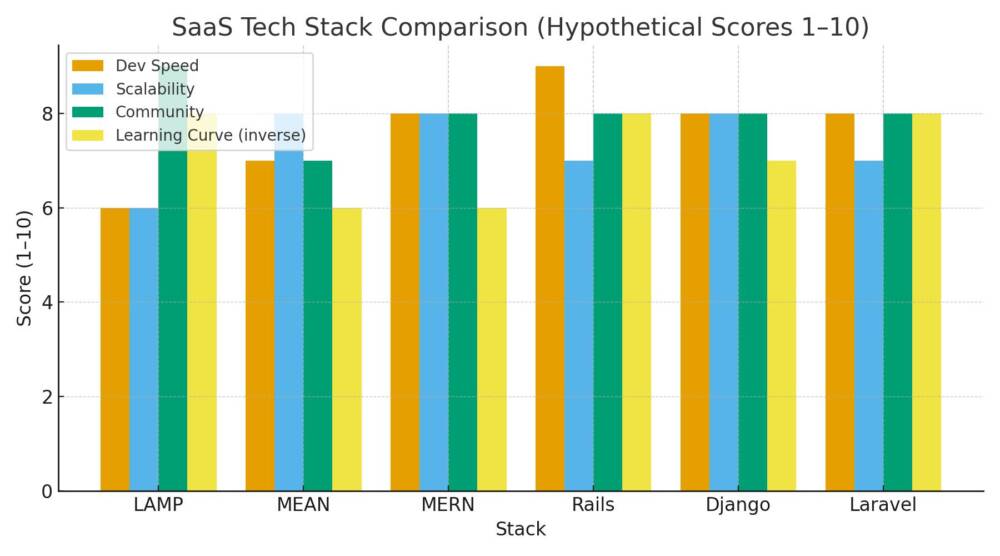 Hypothetical comparison of stacks: development speed, scalability, community, and learning curve.
5) Launch, Product-Led Growth and Marketing That Compounds
The “big launch day” is overrated. Treat launch as a drip: ship something every week and tell the story publicly. That cadence creates learning, trust, backlinks, and momentum. Make your evolution visible: roadmap, changelog, tutorials, and bite-sized case studies. The narrative of constant improvement is a marketing asset in itself.
Product-led growth (PLG) turns the product into a channel. Craft an onboarding that jumps straight to the outcome, add team invites, define usage limits that point to upgrades, and create shareable outputs (public link, exportable report, embeds). When a user experiences value and shares it, you earn new attention without paying for clicks.
Content still rules. “How-to” guides, honest comparisons (“us vs. alternatives”), ROI-backed case studies, and 90-second feature videos tend to convert. Paid spend captures intent: Google Ads for high-intent keywords and LinkedIn for B2B decision makers. Retargeting closes the loop on visitors who showed interest.
Measurement powers the engine: CAC, LTV, churn, activation, time-to-value, trial-to-paid, and expansion (upsell/cross-sell). Optimize the pricing and signup pages with A/B tests. Reduce checkout friction and offer annual plans with a discount to improve cash. And never forget: acquisition without retention is a leaky bucket.
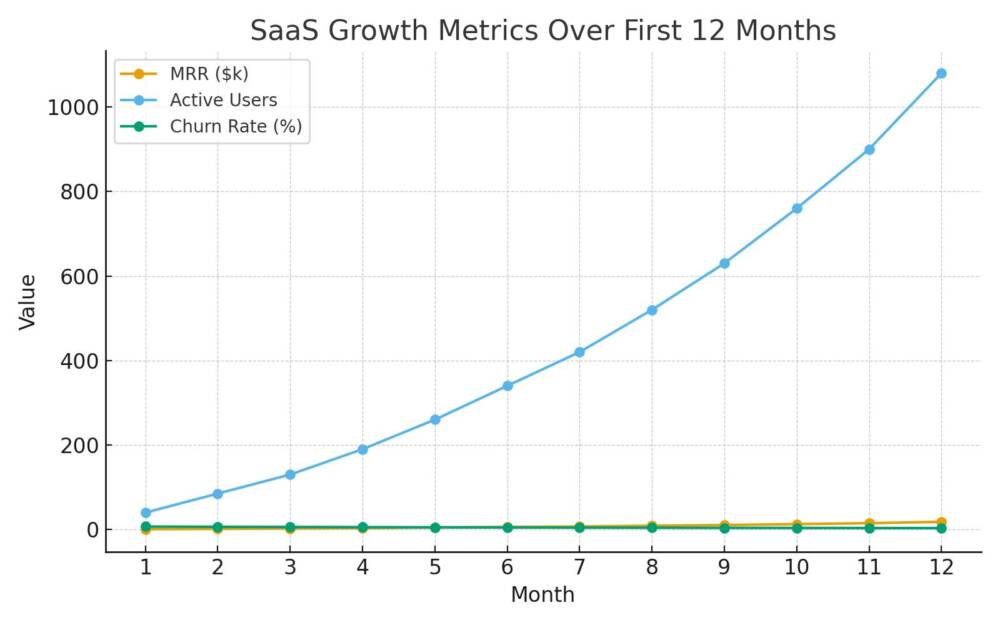 First-year metrics: rising MRR and active users, falling churn. Instrument these from day one.
6) Billing, Churn and Operations: Treat Revenue as a Product
In creating a SaaS product, the “revenue machine” deserves the same craftsmanship as the app itself. Support tiers, add-ons, trials, coupons, proration for mid-cycle changes, monthly/annual billing, and automated tax. Smart dunning, card-updaters, and well-timed retries reduce involuntary churn.
Pricing needs continuous tuning. Start simple and iterate with data: test usage thresholds, paywall premium capabilities, and adopt value metrics (contacts, projects, GB, messages) when they reflect how customers realize value. For enterprise, allow custom quotes and annual contracts with security clauses and SLAs.
Support and Customer Success are competitive advantages. A clear help center, tight SLAs, and a team that resolves issues fast can save at-risk accounts. Schedule proactive check-ins with strategic customers; prevention is cheaper than recovery. Feed recurring ticket themes into the product backlog.
Finally, governance: enforce role-based internal access, log sensitive actions, audit permissions, and keep clean environment separation (dev/staging/prod). These practices both prevent incidents and build confidence with enterprise buyers.
7) Scale, Enterprise and the Road Ahead
Scaling is deciding what not to build. Instead of multiplying modules, deepen the ones that deliver ROI. When demand patterns repeat (e.g., “integration with ERP X”), build a robust connector with excellent docs. Moving up-market? Be ready for SSO, SCIM, advanced reporting, audit controls, and data residency.
Trends to anticipate: Vertical SaaS (industry-specific workflows and language), AI-native features (recommendations, automations, agentic assistance), composable architectures (APIs/micro-frontends to assemble tailored solutions), and SaaS governance (controlling spend and access across sprawling tool stacks). Low-code/no-code continues empowering business teams to prototype without engineering queues—design your product to be extended safely.
If you’re migrating from on-prem to SaaS, take small steps: centralize data first (multi-tenant storage), keep the app layer isolated, then progressively converge services. Repackage contracts into subscriptions and communicate clear benefits: fewer outages, stronger security, continuous releases, and lower TCO over time.
Practical conclusion: the secret isn’t “launch fast” so much as “return to the user’s screen every day.” Validate, focus, charge early, iterate relentlessly, and treat retention as a first-class goal. With tight scope and compounding marketing, creating a SaaS product in 2025 is both feasible and promising.
| Launch Checklist | Status |
|---|---|
| Landing page with clear promise and CTA | ☐ |
| MVP covering one end-to-end workflow | ☐ |
| Billing with tiers, trial, proration and dunning | ☐ |
| Observability (logs/errors/metrics/alerts) | ☐ |
| Onboarding and activation content | ☐ |
| Public roadmap/changelog | ☐ |
| Basic SEO + high-intent ads | ☐ |
| Core metrics (MRR, CAC, LTV, churn, activation) | ☐ |

Janet Ekelt is a seasoned content writer and SEO expert, with experience in digital media. She has held various senior writing positions at enterprises like CloudTDMS (Synthetic Data Factory), Barrownz Group, and ATZA. Janet has also been Editorial Writer at The Irish Times, a leading Irish English language news platform. She excels in content creation, proofreading, and editing, ensuring that every piece is polished and impactful. Her expertise in crafting SEO-friendly content for multiple verticals of businesses, including technology, healthcare, finance, sports, innovation, and more.